
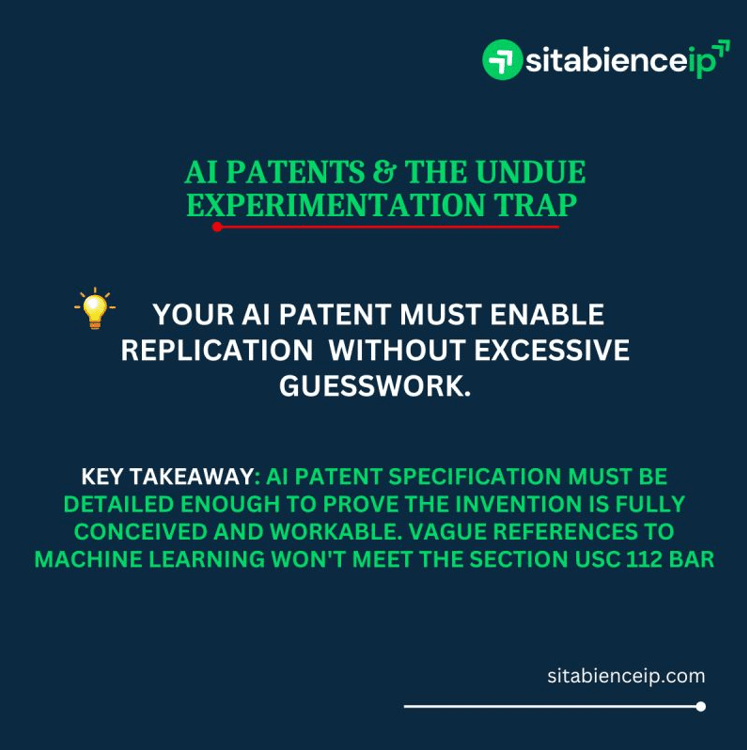
AI and machine learning innovations are uniquely challenging to protect. Unlike standard algorithms that are predictable and precise, AI solutions change based on different data and settings. As a startup founder building AI inventions, understanding best practices to protect your intellectual property is crucial.

Why Special Protection Considerations are Needed:
Protecting AI requires special attention compared to typical software IP for two main reasons:
1. Open-Ended Solutions:
AI systems continue to learn and evolve based on new data. Their fluid nature makes precise descriptions very difficult.2. Undue (Excess) Experimentation:
Patents must provide enough guidance to ensure replication is possible without “undue experimentation.” In other words, the specification must provide sufficient guidance so that the amount of experimentation required is not “undue” for meeting the Section 112 requirements for artificial intelligence/machine language inventions.
Preventing “Undue Experimentation”: When assessing whether experimentation is excessive or inappropriate, three patent application factors can be considered:
1. Specification Details:
Includes working examples and thorough descriptions of the AI system.2. Quantity of Experimentation:
Even with specifics, requiring too much additional work to replicate is still considered undue. For example, In Genentech Inc. v. Novo Nordisk, the U.S. Court of Appeals for the Federal Circuit advised that the specification should disclose “specific starting material and the conditions under which a process can be carried out.”. Takes cues from the case, the starting material in AI, in one example, can be the training data (e.g., whether images, text only, videos, etc).3. Direction Provided in Patent Application:
Clear instructions on model types, training data, and other key information can avoid undue experimentation and help to meet the written description requirement (i.e., Section 112) For example, there can be different types of AI models like a neural network (e.g., a CNN or a DNN), a Markov decision process. However, not all models will be suitable for every type of problem.Best Practices for AI Patent Applications
To meet patent application requirements, at Arctic Invent recommend these AI invention best practices:
1. Specify the Problem:
Clearly state the specific issue being solved, as that dictates suitable models and data. Consider labelled vs unlabelled data and associated algorithms. Ask what was used?2. Detail Model Structures:
Identify model types used, like neural networks or SVMs, to prevent excessive experimentation. Provide a range if one model isn’t universal.3. Describe the Training Process:
Explain how models are trained, including algorithms applied and their integration with architectures.4. Characterize Training Data:
Detail data characteristics, sources, preprocessing needs and compatibility with models. Address real-time model learning if applicable.5. Outline Conditions and Functionality:
Clarify model starting points, operational settings, underlying processes and technical improvements realized through AI components.Key Takeaways for Innovators
When seeking effective patents for AI inventions which can stand in courts, provide specifics rather than simply stating machine learning techniques are used. Define starting points around data, models and conditions to meet application requirements goes a long way in fortifying the quality and legal validity of AI related patents.