Sitabience

blogs

What is the right way to protect AI inventions using patents

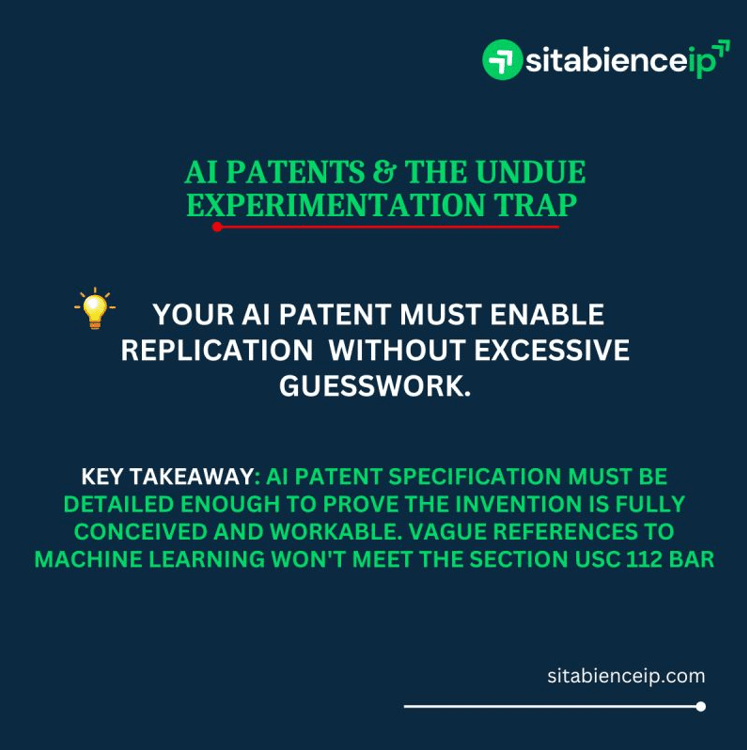
AI and machine learning innovations are uniquely challenging to protect. Unlike standard algorithms that are predictable and precise, AI solutions change based on different data and settings. As a startup founder building AI inventions, understanding best practices to protect your intellectual property is crucial. Why Special Protection Considerations are Needed: Protecting AI requires special attention compared to typical software IP for two main reasons: 1. Open-Ended Solutions: AI systems continue to learn and evolve based on new data. Their fluid nature makes precise descriptions very difficult. 2. Undue (Excess) Experimentation: Patents must provide enough guidance to ensure replication is possible without “undue experimentation.” In other words, the specification must provide sufficient guidance so that the amount of experimentation required is not “undue” for meeting the Section 112 requirements for artificial intelligence/machine language inventions. Preventing “Undue Experimentation”: When assessing whether experimentation is excessive or inappropriate, three patent application factors can be considered: 1. Specification Details: Includes working examples and thorough descriptions of the AI system. 2. Quantity of Experimentation: Even with specifics, requiring too much additional work to replicate is still considered undue. For example, In Genentech Inc. v. Novo Nordisk, the U.S. Court of Appeals for the Federal Circuit advised that the specification should disclose “specific starting material and the conditions under which a process can be carried out.”. Takes cues from the case, the starting material in AI, in one example, can be the training data (e.g., whether images, text only, videos, etc). 3. Direction Provided in Patent Application: Clear instructions on model types, training data, and other key information can avoid undue experimentation and help to meet the written description requirement (i.e., Section 112) For example, there can be different types of AI models like a neural network (e.g., a CNN or a DNN), a Markov decision process. However, not all models will be suitable for every type of problem. Best Practices for AI Patent Applications To meet patent application requirements, at Arctic Invent recommend these AI invention best practices: 1. Specify the Problem: Clearly state the specific issue being solved, as that dictates suitable models and data. Consider labelled vs unlabelled data and associated algorithms. Ask what was used? 2. Detail Model Structures: Identify model types used, like neural networks or SVMs, to prevent excessive experimentation. Provide a range if one model isn’t universal. 3. Describe the Training Process: Explain how models are trained, including algorithms applied and their integration with architectures. 4. Characterize Training Data: Detail data characteristics, sources, preprocessing needs and compatibility with models. Address real-time model learning if applicable. 5. Outline Conditions and Functionality: Clarify model starting points, operational settings, underlying processes and technical improvements realized through AI components. Key Takeaways for Innovators When seeking effective patents for AI inventions which can stand in courts, provide specifics rather than simply stating machine learning techniques are used. Define starting points around data, models and conditions to meet application requirements goes a long way in fortifying the quality and legal validity of AI related patents.

What is the right way to protect AI inventions using patents Read More »
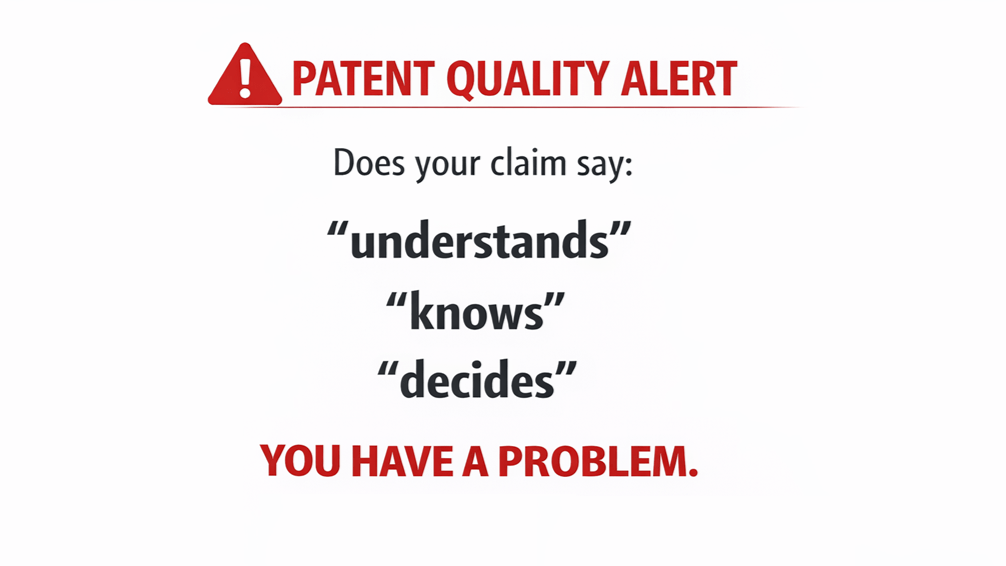
Does Your Patent Say “Understands” or “Knows”? You Have a Problem.

The “Anthropomorphism” Trap in Patent Drafting When describing your software, do you say it “understands” users? Or that your system “knows” what to do next? . These words feel natural. But in patents, they create serious problems. Let me explain why and how to fix it. What’s the Issue? We naturally describe technology like it’s human. We say our app “thinks,” our algorithm “understands,” our device “knows” what to do next. These are called anthropomorphic terms – simply put, human words used for machines. Here’s the problem: Human words describe what something appears to do. Patents must explain how it actually works. When you write “the system understands user commands,” a patent examiner asks: What does “understand” mean technically? What exact steps happen inside? If the patent description does not elaborate and isn’t clear, your patent may face a rejection – or gets granted but becomes almost impossible to enforce. A Real Case: One Word, Total Loss In Chef America v. Lamb-Weston (2004), a company lost its patent over one word. Their claim said heat dough “to“ 850°F. Their internal documents said “at“ 850°F. The court ruled these mean different things—”to” implies the dough itself reaches that temperature, which would burn it. The company argued this was obviously a drafting mistake. The court’s response was blunt: “Courts may not redraft claims.” If “to” versus “at” matters this much, imagine what “understands” versus “processes and matches” means for your patent’s strength. Three Ways This Hurts Your Patent 1. Rejections During Examination The USPTO requires claims to clearly define your invention’s boundaries. The Federal Circuit has ruled that claim language cannot be “ambiguous, vague, or unclear.” Words like “knows” and “decides” fails this test. Such words describe human thinking, but machines don’t think. Machines execute specific operations. Examiners want to see those operations spelled out. 2. Narrow Scope That Competitors Exploit Sometimes patents get granted but become worthless later. The claims may get invalidated where applicants write “processor configured to understand/observe” but never explained the actual steps involved. Without those steps in your specification, your “broad” claim shrinks to nothing. Better, to simply avoid the “anthropomorphic” terms. Your competitor reads your patent, spots the gap, builds something slightly different, and walks free. 3. Validity Challenges in Court US patent law excludes “abstract ideas” from protection. When your patent uses words like “recognizes” or “interprets,” opponents argue: A human mind can do this too. This isn’t a real technical invention—it’s just a concept. Courts have accepted this argument repeatedly. In Synopsys v. Mentor Graphics (2016), the Federal Circuit rejected patents because the claims covered “nothing other than pure mental steps.” The Fix: Say What the Machine Actually Does Replace human words with technical actions. Describe the steps, not the impression   The left column describes an impression / human word for machines. The right column describes a technical mechanism by a technical/tangible unit. Patents protect technical mechanisms. A Simple Check Before Filing Run this quick audit on every draft: Step 1: Search for red-flag words—understand, know, recognize, decide, learn, think, believe, realize, interpret, figure out Step 2: For each occurrence, ask: Can I replace this with words describing actual operations? Have I explained somewhere how this technically happens? Would an engineer reading this know exactly what steps occur? Step 3: Apply the “human test”—if a person could do the described action using only their mind, you need more technical detail.  Special Care for AI Patents AI inventions face extra risk because the field’s vocabulary is inherently human-sounding. “Machine learning.” “Neural networks.” “Training.” “Inference.” These terms are standard—but your patent must go deeper. Don’t just say your model “learns patterns.” Explain the mechanism: what data enters, what calculations run, how parameters update, what outputs emerge. Patent offices worldwide—USPTO, EPO, KIPO, India, – all emphasize this. Abstract capabilities don’t earn worthy patents. Concrete implementations do.  The Bottom Line Every human-sounding word in your patent is a potential weak point—during examination, in licensing talks, or under litigation. The fix isn’t complicated. Describe how your technology works, not what it seems to do. Be specific. Be technical. Leave no room for interpretation. Describe the machine, not the human-sounding magic. That’s how quality patents get granted, survive challenges, and actually protect your business in the long term and when in need resulting in a high-quality standards and enforceable patent portfolio.

Does Your Patent Say “Understands” or “Knows”? You Have a Problem. Read More »

Smart IP Strategy: How to patent for VC attention?

Smart IP Strategy: How to patent for VC attention? Startups often underestimate the power of a well-crafted patent when pitching to investors. But for venture capitalists (VCs), a strong IP portfolio isn’t just a legal asset — it’s a signal. It tells them you’re solving a hard problem, you own your innovation, and you’re building with long-term defensibility. So, how do you turn your patent strategy into a fundraising magnet? 1. Think Business, Not Just Protection VCs invest in market potential, not legal complexity. A patent that’s packed with legal jargon but lacks a story about why the invention matters won’t land. Your claims should align with your product roadmap and your market differentiators. Tip: Start with the “Why now?” of your innovation. Build your patent to reflect that urgency and uniqueness. 2. Draft for Clarity, Not Just Coverage Impress with how well your IP explains your tech. VCs aren’t reading the claims — but their technical advisors might. A confusing or generic patent won’t help. Clear enablement, sharp language, and tight figures = instant credibility. Further, it’s a skill and an art as well in terms of how to write to make it patentable. Tip: Avoid jargon unless it’s precise. Use flowcharts and block diagrams to support storytelling. BEFORE(AI Invention – Not Patentable) AFTER(Same AI Invention – rewritten to be Patentable) Claim 1. A method of using an artificial neural network (ANN) comprising: Claim 1. A method of using an artificial neural network (ANN) to detect malicious network packets comprising: (a) receiving, at a computer, continuous training data (a) training, by a computer, the ANN based on input data and a selected training algorithm to generate a trained ANN, wherein the selected training algorithm includes a backpropagation algorithm and a gradient descent algorithm (b) discretizing, by the computer, the continuous training data to generate input data (b) detecting one or more anomalies in network traffic using the trained ANN (c) training, by the computer, the ANN based on the input data and a selected training algorithm to generate a trained ANN, wherein the selected training algorithm includes a backpropagation algorithm and a gradient descent algorithm (c) determining at least one detected anomaly is associated with one or more malicious network packets (d) detecting one or more anomalies in a data set using the trained ANN (d) detecting a source address associated with the one or more malicious network packets in real time (e) analyzing the one or more detected anomalies using the trained ANN to generate anomaly data, and (e) dropping the one or more malicious network packets in real time, and (f) outputting the anomaly data from the trained ANN. (f) blocking future traffic from the source address.   3. Show Portfolio Thinking Early One patent is good. A strategy is better Even if you’re starting with a single filing, show the potential for a broader IP moat. Highlight how other features or upcoming modules could lead to follow-on filings. Tip: Include a roadmap-style slide in your deck: “Current Patent + 2 Future Filings Planned.” 4. File Smart, File Early Timing matters. So does jurisdiction File before public disclosure, and if you’re targeting global markets, consider US or EP filings early. The perception of “global IP” adds serious weight in investor conversations. Tip: Use provisional filings smartly. File one aligned with your MVP and another before fundraising. 5. Talk About IP in the Right Language Don’t say: “We have a patent.” Say: “We’ve protected the algorithm that makes our product 3x faster than competitors — and it’s granted in the US.” Make your IP a business asset, not a legal ornament. Tip: Practice explaining your patent in one sentence that makes a VC say, “Oh, that’s valuable.” Final Thought: Patents won’t raise your round for you. But they will: In Short: A good patent says, “This founder is serious.” Want help creating investor-grade IP? Book a free discovery call with SITABIENCE IP.

Smart IP Strategy: How to patent for VC attention? Read More »