

The "Anthropomorphism” Trap in Patent Drafting
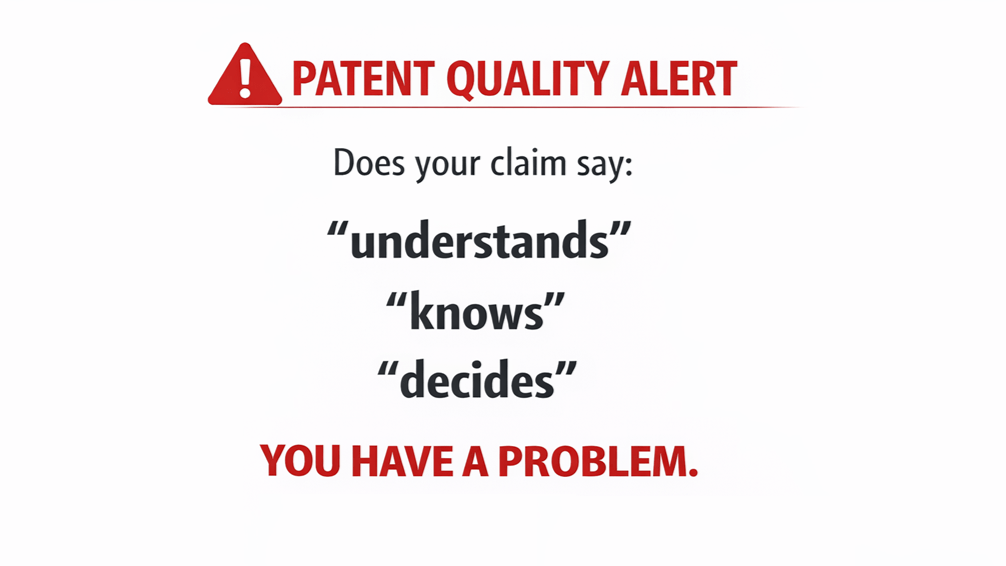
When describing your software, do you say it “understands” users? Or that your system “knows” what to do next? . These words feel natural. But in patents, they create serious problems.
Let me explain why and how to fix it.
What’s the Issue?
We naturally describe technology like it’s human. We say our app “thinks,” our algorithm “understands,” our device “knows” what to do next.
These are called anthropomorphic terms – simply put, human words used for machines.
Here’s the problem:
Human words describe what something appears to do. Patents must explain how it actually works.
When you write “the system understands user commands,” a patent examiner asks: What does “understand” mean technically? What exact steps happen inside?
If the patent description does not elaborate and isn’t clear, your patent may face a rejection – or gets granted but becomes almost impossible to enforce.
A Real Case: One Word, Total Loss
In Chef America v. Lamb-Weston (2004), a company lost its patent over one word.
Their claim said heat dough “to“ 850°F. Their internal documents said “at“ 850°F. The court ruled these mean different things—”to” implies the dough itself reaches that temperature, which would burn it.
The company argued this was obviously a drafting mistake. The court’s response was blunt:
“Courts may not redraft claims.”
If “to” versus “at” matters this much, imagine what “understands” versus “processes and matches” means for your patent’s strength.
Three Ways This Hurts Your Patent
1. Rejections During Examination
The USPTO requires claims to clearly define your invention’s boundaries. The Federal Circuit has ruled that claim language cannot be “ambiguous, vague, or unclear.”
Words like “knows” and “decides” fails this test. Such words describe human thinking, but machines don’t think. Machines execute specific operations. Examiners want to see those operations spelled out.
2. Narrow Scope That Competitors Exploit
Sometimes patents get granted but become worthless later.
The claims may get invalidated where applicants write “processor configured to understand/observe” but never explained the actual steps involved. Without those steps in your specification, your “broad” claim shrinks to nothing. Better, to simply avoid the “anthropomorphic” terms.
Your competitor reads your patent, spots the gap, builds something slightly different, and walks free.
3. Validity Challenges in Court
US patent law excludes “abstract ideas” from protection. When your patent uses words like “recognizes” or “interprets,” opponents argue: A human mind can do this too. This isn’t a real technical invention—it’s just a concept.
Courts have accepted this argument repeatedly. In Synopsys v. Mentor Graphics (2016), the Federal Circuit rejected patents because the claims covered “nothing other than pure mental steps.”
The Fix: Say What the Machine Actually Does
Replace human words with technical actions. Describe the steps, not the impression
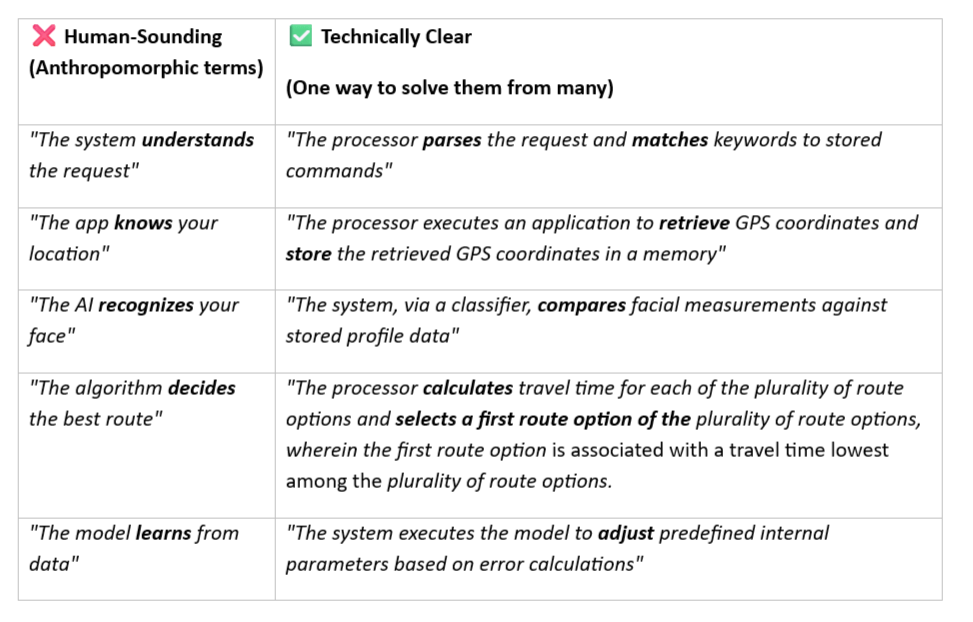
The left column describes an impression / human word for machines. The right column describes a technical mechanism by a technical/tangible unit.
Patents protect technical mechanisms.
A Simple Check Before Filing
Run this quick audit on every draft:
Step 1: Search for red-flag words—understand, know, recognize, decide, learn, think, believe, realize, interpret, figure out
Step 2: For each occurrence, ask:
- Can I replace this with words describing actual operations?
- Have I explained somewhere how this technically happens?
- Would an engineer reading this know exactly what steps occur?
Step 3: Apply the “human test”—if a person could do the described action using only their mind, you need more technical detail.
Special Care for AI Patents
AI inventions face extra risk because the field’s vocabulary is inherently human-sounding. “Machine learning.” “Neural networks.” “Training.” “Inference.”
These terms are standard—but your patent must go deeper.
Don’t just say your model “learns patterns.” Explain the mechanism: what data enters, what calculations run, how parameters update, what outputs emerge.
Patent offices worldwide—USPTO, EPO, KIPO, India, – all emphasize this. Abstract capabilities don’t earn worthy patents. Concrete implementations do.
The Bottom Line
Every human-sounding word in your patent is a potential weak point—during examination, in licensing talks, or under litigation.
The fix isn’t complicated. Describe how your technology works, not what it seems to do. Be specific. Be technical. Leave no room for interpretation.
Describe the machine, not the human-sounding magic.
That’s how quality patents get granted, survive challenges, and actually protect your business in the long term and when in need resulting in a high-quality standards and enforceable patent portfolio.